Save Downtown Chico / A Citizens' CoalitionUpdated Oct 19, 2026
SAVE DOWNTOWN CHICO
A citizen effort to revive the Downtown Revitalization Project
Downtown Chico deserves better streets. The council split 3–3 and the plan stalled.
A dozen storefronts shuttered downtown in the last year. Main and Broadway are built as a thoroughfare, not a destination — and downtown is paying the price. The Downtown Revitalization Project would widen the sidewalks, calm the traffic, and give people a reason to stop and stay. On April 21, 2026 the council split 3–3, with one member recused, and the project did not move forward.3
Update — Oct 19, 2026
The grant deadline has passed.
The Caltrans Active Transportation Program Cycle 8 application deadline came and went on June 22, 2026 without an application from Chico.7 The case for the project hasn't changed: safer streets, wider sidewalks and a downtown people want to spend time in. We hope the city finds a way to do this in the future.
Section 01The case for revitalization
Downtown is built to drive through, not to be in.
Three travel lanes in each direction on Main and Broadway optimize for one thing: getting across town. They don't make downtown a place worth stopping. The result, year after year, is closed storefronts, empty patios, and a core that only feels alive on Thursday nights — when the streets are closed to cars.
The Downtown Revitalization Project — Alternative 1 — fixes that. Wider sidewalks for outdoor dining, real on-street loading for businesses, calmer traffic, safer crossings, and a real bike connection from Bidwell Park into downtown. Caltrans' Active Transportation Program can cover 80–92% of the cost.7
12
Downtown storefronts closed in the last year
Doing nothing is the experiment that's already failing
$40–50M
Alternative 1 estimated cost
An ATP grant could cover 80–92%; city matches 8–20%167
Jun 22
Caltrans ATP Cycle 8 deadline (passed)
Chico did not apply; the project would need a future cycle7
14
Pedestrian crashes on Main & Broadway, 2021–2025
Most cited cause: drivers failing to yield in crosswalks24
Twelve closures. One year. One downtown.
These are the storefronts that left in the last year alone.
Panama Bar & Cafe
Cheers Chico
The Winchester Goose
Tomfoolery Gifts & Gadgets
Momona
Coin-Op
Smokin' Mo's
Collier Hardware
Starbucks
Woodzee
Lulu's Warehouse
Lulu's Outlet
Some closed for one reason, some for another — but ask anyone who lives here and the picture is the same: downtown is hurting under the current design. The opposition's pitch is "don't change anything." That's the experiment we just ran. It's not working.
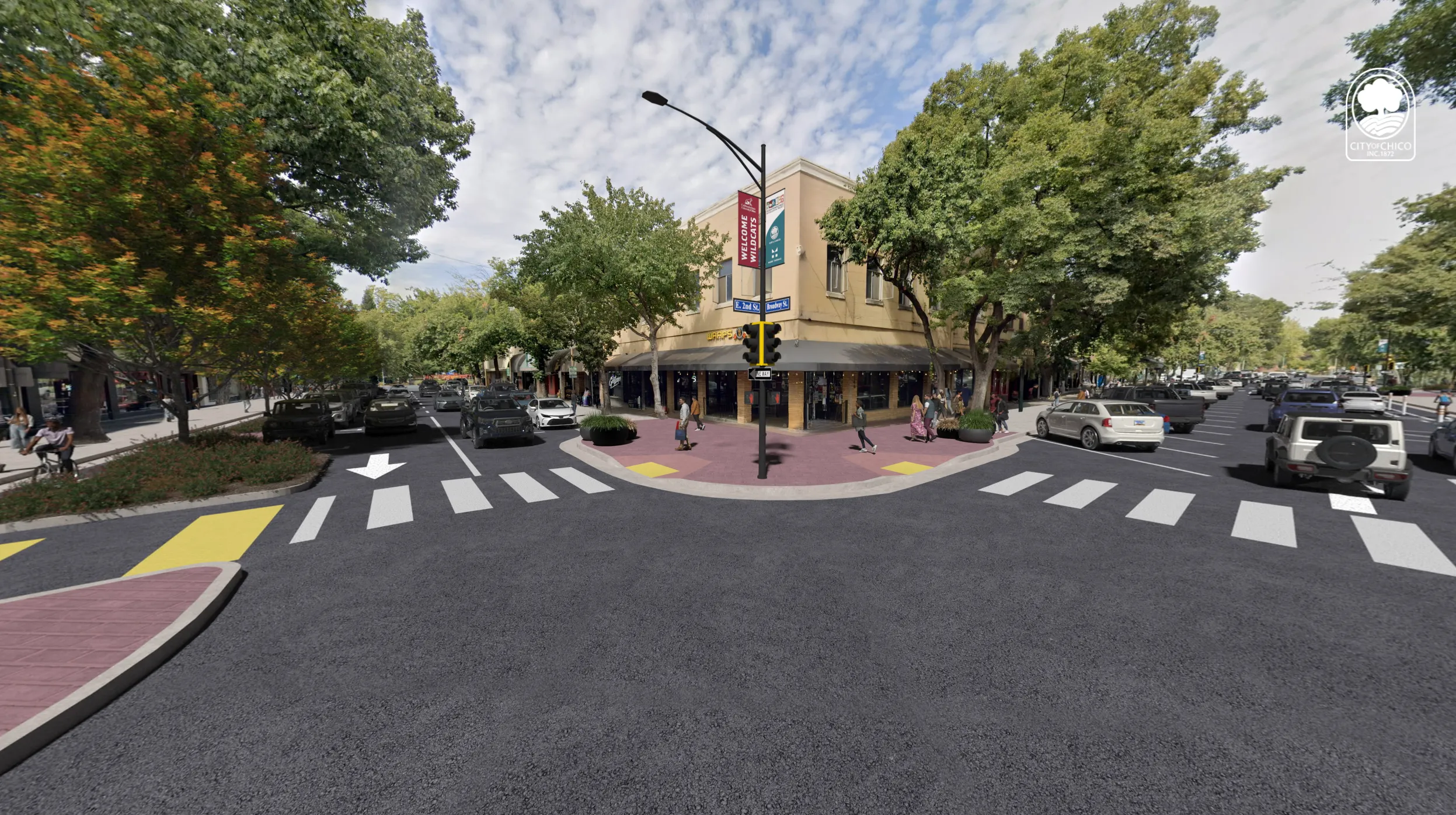
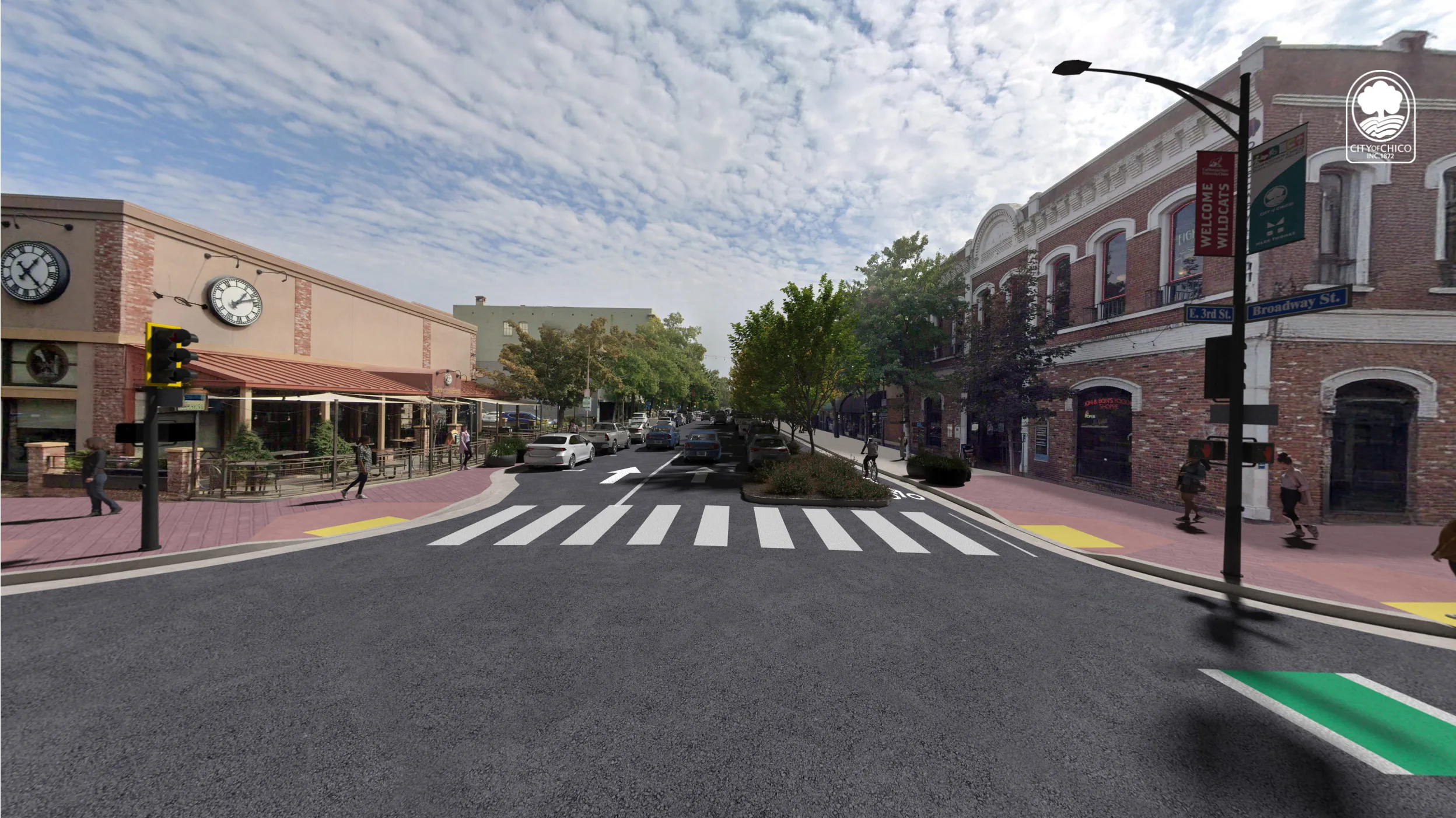
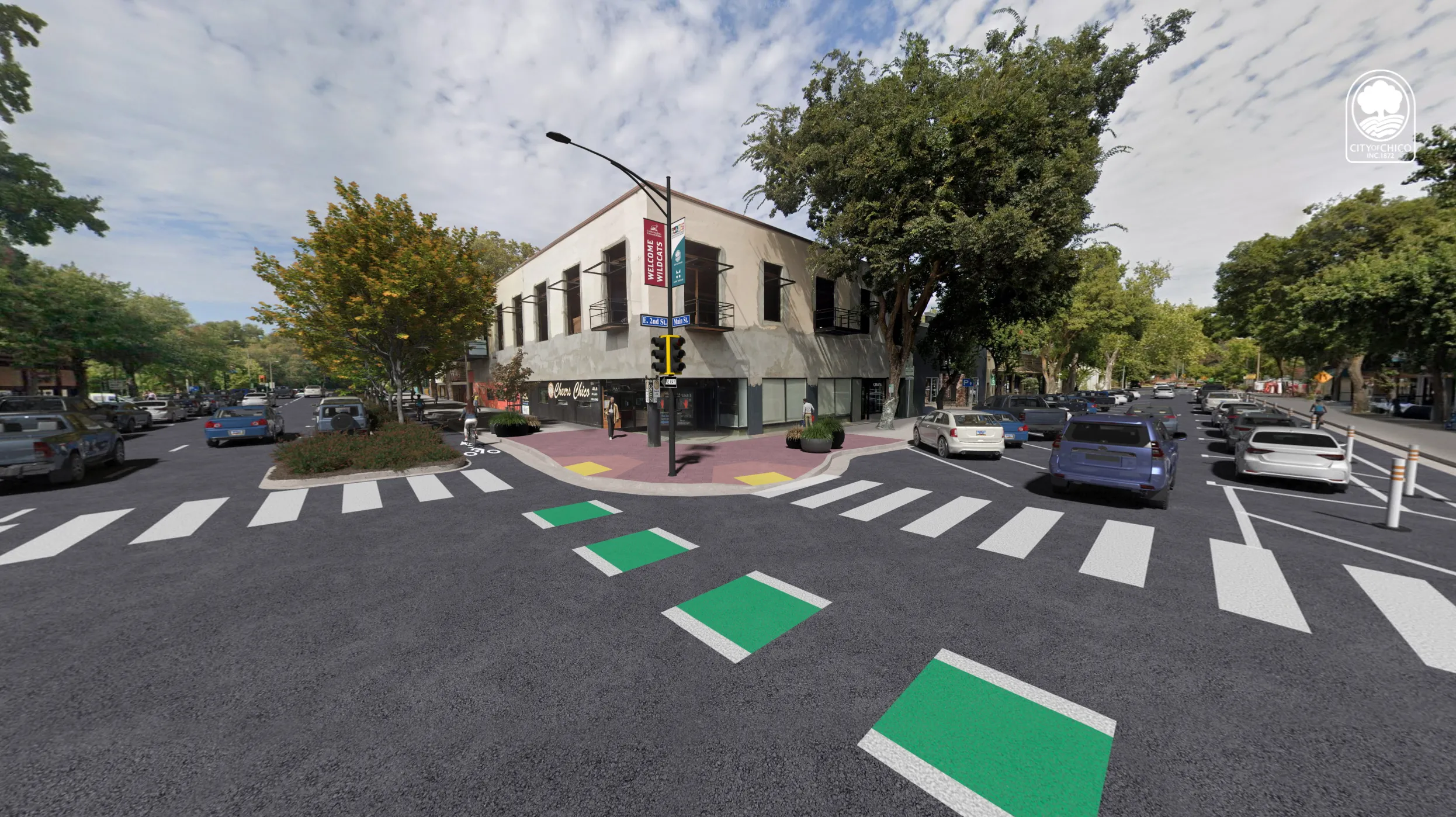
↓ This is what we'd be building
Broadway & 3rd · City of Chico rendering
Wider sidewalks. Outdoor seating. People, not just cars.
Same Broadway, same block, same buildings — designed to invite people to stop, eat, shop, and stay. This is the version where downtown businesses get foot traffic instead of pass-through traffic.
Main Street — Today Cross-section
Three undifferentiated travel lanes. Narrow sidewalks. No bike infrastructure. 1
Main Street — Alt 1 proposed Cross-section
Two travel lanes. Widened sidewalk. A protected one-way bike lane buffered from traffic.
Broadway — Today Cross-section
Same story on Broadway today: three travel lanes, narrow sidewalks, nowhere safe to bike.
Broadway — Alt 1 proposed Cross-section
Two travel lanes. Wider sidewalks. Protected bike lane in the opposite direction. Flex parking.
→ Cross-sections from City of Chico Downtown Revitalization Project documents.
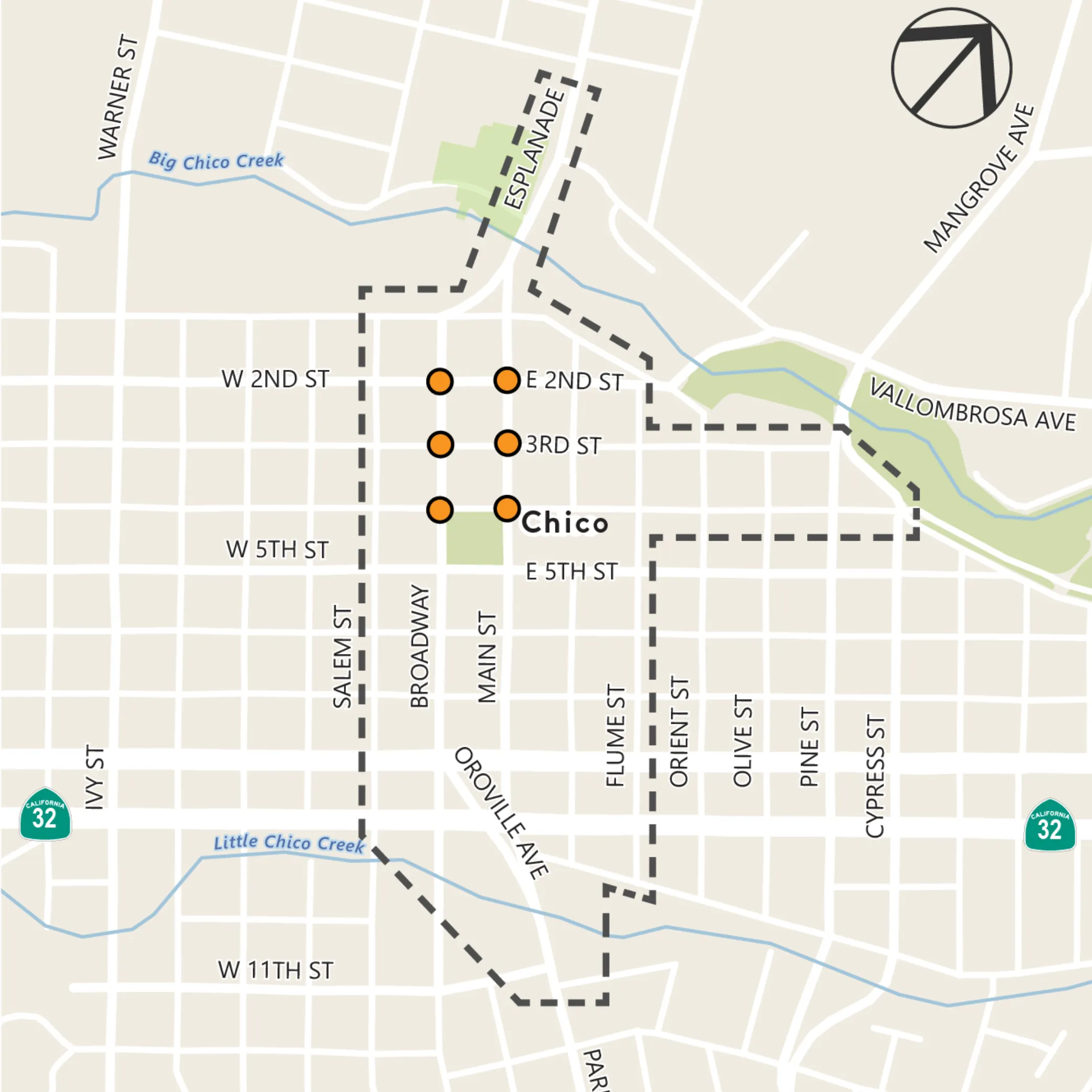
Project area — Main & Broadway, 2nd to 5thCity of Chico project documents
Six blocks. That's the whole argument.
Every block within the dashed line gets wider sidewalks, calmer traffic, real loading zones for delivery trucks, and the kind of street businesses can actually grow on. The orange dots mark the intersections that get real fixes.
→ Click any rendering to explore the City of Chico's interactive 360° AR tour of Alternative 1. Full set at downtownchicoplan.com.
Widened sidewalks
Room for outdoor dining, sidewalk seating, benches, and walking with a friend without single-filing. Today's Broadway sidewalks are barely 6 feet wide in places.
Flex parking & loading zones
On-street spaces that work as loading/pickup during delivery hours and as regular customer parking the rest of the day. Better for businesses than the current double-park-and-block-traffic system.
Safer, shorter crossings
Curb extensions, better signals, and shorter pedestrian distances at the intersections people already cross. Easier for shoppers, families, and older neighbors.
Protected bike lanes
A real bike connection through downtown — separated from traffic by a striped buffer and flex zone. More foot traffic, less worry about getting hit.
Bidwell Park connection
The first safe bike-and-walk connection between the park and downtown businesses. Right now there isn't one.
Recused — owns downtown property with tenants Parkside Tap House, Metric Cosmetics, and KRCR
Timeline
Jan 17, 2023
On the agenda
"Redesigning streets first" placed on the Council agenda as a path to a downtown revitalization.
Feb 7, 2023
First discussion & vote
Council takes up the redesign concept for the first time and votes to move it forward.
Dec 2023
Internal Affairs Committee recommends it
IAC votes to recommend moving the project forward — motion by Tom, seconded by Kasey Reynolds.
Mar 5, 2024
Council delays for more input
Council puts the project off for more community input — causing Chico to miss the 2024–2025 ATP grant cycle entirely.
May 2025
Community workshops
Old Municipal Building drop-in sessions — majority of comment favorable.1
Apr 7, 2026
First vote: 3–3 tie
Mayor Reynolds votes no but says she's 'close to voting yes' — agrees to one more input session.45
Apr 14, 2026
Final input session
Record public turnout. Young residents and families overwhelmingly supportive.3
Apr 21, 2026
Second vote: 3–3 tie
Reynolds votes no again. Alternative 1 fails. Van Overbeek recused for business-ownership reasons.3
Jun 22, 2026
Grant deadline passed
Caltrans ATP Cycle 8 applications closed without an application from Chico for this project. The next opportunity is a future ATP cycle.7
Oct 15, 2026
FPPC closes complaint: no action
The FPPC's Enforcement Division closed its investigation into Mayor Reynolds' participation in the vote, finding insufficient evidence of a violation.29
The economic case is settled. The rest of the objections fall apart with it.
The headline objection is "this will hurt downtown businesses." Every credible study of streets that actually got redesigned says the opposite — and the status quo is already closing storefronts. Tap the first claim for the receipts. The other six are the standard road-diet fears, and they've failed everywhere they've been tested too.
Twelve downtown storefronts closed in the last year under the existing three-lanes-each-direction design. "Don't change anything" is the experiment we just ran, and it didn't work. Meanwhile, every credible study of streets that actually got redesigned points the other way. After NYC installed a protected bike lane on 9th Avenue, retail sales jumped 49% vs. 3% borough-wide. Salt Lake City's 300 South redesign — which removed 30% of on-street parking — saw sales grow 8.8% vs. 7% citywide, and 59% of business owners supported the change after it was built. A 2020 Portland State study across 14 corridors in six cities found positive or statistically-insignificant impacts on retail everywhere it looked. A 2021 peer-reviewed review of 23 North American studies concluded that "fears of disastrous consequences for local businesses are unfounded." Strong Towns has documented the same effect over and over: streets built for all users see higher commercial property values and lower vacancy rates. The slow-pace, walkable street invites people to spend time — and money. Three travel lanes optimized for driving through downtown invite the opposite.910111220212223
Chicago DOT studied this exact prediction on Kinzie Street. Eastbound morning travel time went up by under a minute. Westbound got faster. Evening rush improved in both directions.13
Section 04Conflict-of-interest complaints
The recusal question.
Tom Van Overbeek owns — as he puts it — "half a block" in downtown Chico, renting to Parkside Tap House, Metric Cosmetics, and the KRCR news station.19 He recused himself from both votes.3 That's what California's Political Reform Act asks of an official with a financial interest in a decision in front of them.2526 Mayor Reynolds, whose family owns Shubert's Ice Cream & Candy on 7th Street,15 did not recuse. Members of the public filed sworn complaints with the Fair Political Practices Commission arguing that she should have.
Update — Oct 19, 2026
The FPPC closed the matter with no action.
Following sworn complaints, the FPPC's Enforcement Division conducted a Commission-initiated investigation into whether Mayor Reynolds violated §87100 by taking part in the council's decisions on the project. On Oct 15, 2026 it closed the matter without further action.29
The FPPC found that she has an interest in Shubert's, Inc. as a business entity and source of income, but not in the underlying real property: Shubert's operates on a month-to-month tenancy, and under the Political Reform Act a month-to-month tenancy is not a real property interest. As to the business entity and source of income, it found insufficient evidence to support a finding that she violated the Act.29
We're leaving the argument the complaints made below as a record of the question that was raised. The FPPC's letter is the answer.
Project area + Shubert's location178 E. 7th St · within the project area
The rule the complaints cited
Cal. Gov. Code §87100
Under California's Political Reform Act, a public official may not make, participate in, or use their position to influence a governmental decision in which they have a financial interest.25
§87103 defines that financial interest broadly — it includes any business entity in which the official has a $2,000+ ownership interest, any source of $500+ in income in the prior twelve months, and any business entity in which the official holds a position of management.26
Complainants argued that you don't have to own the building: owning the business, drawing income from it, or running it is, on its own, a qualifying interest. Whether that interest required recusal on these votes is the question the FPPC answered above.
He owns roughly half a block of downtown property — tenants include Parkside Tap House, Metric Cosmetics, and KRCR's Chico newsroom. The project would reshape the streets his buildings sit on. So he stepped out of both votes.
What Mayor Reynolds did
Voted no.
The Reynolds family business, Shubert's Ice Cream & Candy at 178 E. 7th Street,15 is within the Downtown Revitalization Project area, half a block off Main. She did not recuse, and she voted no on both the April 7 and April 21 votes.35 The FPPC later found she has no real property interest there and found insufficient evidence of a violation.29
The argument complainants made
The complaints walked through the FPPC's three-step business-entity analysis. This is their argument, not a finding — see the FPPC's conclusion above.
Step 1 — The interest
Owner. Manager. Source of income.
§87103(a) · (c) · (d)
Complainants pointed to Mayor Reynolds' publicly filed Form 700 to argue that she is a co-owner of Shubert's, holds a position of management, and draws income from the business.
In their view, that clears the §87103 threshold three different ways, independent of who holds the deed.26 The FPPC agreed she has a business-entity and source-of-income interest; it found no real property interest.29
Step 2 — Foreseeability
"Realistic possibility — more than hypothetical."
FPPC Reg. 18701(b)
The standard isn't certainty of a financial impact. It's whether one is a realistic possibility.8
Complainants argued that multi-month street reconstruction near the shop — changes to traffic flow, on-street parking, sidewalk frontage, the character of the block — meets that bar, regardless of whether the long-term effect on revenue is positive or negative.
Step 3 — No "public generally" escape
A few blocks downtown isn't "the public generally."
FPPC Reg. 18703
A conflicted official can sometimes still vote if the same effect hits a "significant segment" — at least 25% — of the businesses in their jurisdiction.28
Complainants noted that the downtown project area is a small fraction of Chico's businesses, well under the 25% threshold, and that Councilmember Van Overbeek had already worked through this analysis for the same project area and concluded he had to recuse. They argued the exception would not apply to Mayor Reynolds either.
Section 05The supporter wall
Add your name. Show the council how many of us there are.
Every name on this wall is a Chico resident who wants the Downtown Revitalization Project to happen. The list grows in real time — when you add your name it appears here within seconds.
0
Chico supporters on the record
Momentum is building. Add yours.
The wall of supporters
Vangs Plants & Succulents Hub
Downtown business
Spruce Studio Films
Downtown business
Outlier Architecture
Downtown business
Upper Park Clothing
Downtown business
The Westport Event Venue
Downtown business
Lovebird Coffee
Downtown business
MC&Co Salon
Downtown business
Golden Thread Strategies
Downtown business
Aca Taco
Downtown business
Peter Washington Law
Downtown business
Poppy & Fig Clothing
Downtown business
Social High Rise
Downtown business
Second Cousin Gallery
Downtown business
Stoble Coffee
Downtown business
Anika Burke
Downtown business
Adema Environmental
Downtown business
Rawbar
Downtown business
Law Office of Davis Hewitt
Downtown business
Lili’s Brazilian Bistro
Downtown business
Chico Velo
Downtown business
Sign Club
Downtown business
Letters on file20 signed letters of support
Downtown didn't just sign on — they wrote letters.
Section 06Contact
Stay in touch with your council.
Councilmembers hear from residents every week, and it matters. If safer streets and a livelier downtown are important to you, let your councilmember know — respectfully, in your own words, and as often as it's on your mind. A short note about what you care about and where you live goes a long way.
[24]CalWalks Community Pedestrian & Bicycle Safety Training — Chico Planning Meeting #2 (Apr 13, 2026); data from SWITRS / CA Office of Traffic Safety, 2021–2025 (2024–2025 provisional). Slide deck shared by program staff; not publicly posted.
'%3e%3cpath%20d='M84.6738%20198.058V228H48C37.6331%20228%2028.0342%20224.713%2020.1875%20219.125L88.1191%20151.194L84.6738%20198.058Z'%20fill='%2300501B'/%3e%3cpath%20d='M125.674%20206.352V228H100.674V206.352H125.674Z'%20fill='%2300501B'/%3e%3cpath%20d='M207.812%20219.126C199.965%20224.713%20190.366%20228%20180%20228H141.674V198.058L138.097%20149.411L207.812%20219.126Z'%20fill='%2300501B'/%3e%3cpath%20d='M169.502%20142.426H228V180C228%20190.366%20224.713%20199.965%20219.126%20207.812L151.488%20140.174L169.502%20142.426Z'%20fill='%2300501B'/%3e%3cpath%20d='M8.87305%20207.811C3.28605%20199.964%207.55863e-08%20190.366%200%20180V142.07C1.4659%20142.303%202.96868%20142.426%204.5%20142.426H58.498L76.5107%20140.174L8.87305%20207.811Z'%20fill='%2300501B'/%3e%3cpath%20d='M104.73%20143.462C108.091%20144.684%20111.717%20145.352%20115.5%20145.352C117.626%20145.352%20119.702%20145.14%20121.71%20144.738L125.064%20190.352H101.284L104.73%20143.462Z'%20fill='%2300501B'/%3e%3cpath%20d='M50%20101.426V126.426H4.5C2.91307%20126.426%201.39669%20126.126%200%20125.587V102.264C1.3966%20101.724%202.9132%20101.426%204.5%20101.426H50Z'%20fill='%2300501B'/%3e%3cpath%20d='M228%20101.426V126.426H178V101.426H228Z'%20fill='%2300501B'/%3e%3cpath%20d='M85.292%20104.899C84.4523%20107.737%2084%20110.741%2084%20113.852C84%20117.013%2084.4681%20120.066%2085.335%20122.945L66%20125.363V102.488L85.292%20104.899Z'%20fill='%2300501B'/%3e%3cpath%20d='M162%20125.363L145.555%20123.307C146.493%20120.322%20147%20117.146%20147%20113.852C147%20110.609%20146.51%20107.481%20145.6%20104.537L162%20102.488V125.363Z'%20fill='%2300501B'/%3e%3cpath%20d='M76.3408%2087.6553L58.498%2085.4258H4.5C2.96873%2085.4258%201.46586%2085.5478%200%2085.7803V48C0%2037.6335%203.28549%2028.034%208.87305%2020.1875L76.3408%2087.6553Z'%20fill='%2300501B'/%3e%3cpath%20d='M219.125%2020.1875C224.713%2028.0342%20228%2037.6331%20228%2048V85.4258H169.502L151.658%2087.6553L219.125%2020.1875Z'%20fill='%2300501B'/%3e%3cpath%20d='M125.063%2038.3516L121.781%2082.9785C119.751%2082.5678%20117.651%2082.3516%20115.5%2082.3516C111.691%2082.3516%20108.039%2083.0268%20104.659%2084.2656L101.283%2038.3516H125.063Z'%20fill='%2300501B'/%3e%3cpath%20d='M180%200C190.366%200%20199.964%203.28605%20207.811%208.87305L138.152%2078.5322L141.674%2030.6455V0H180Z'%20fill='%2300501B'/%3e%3cpath%20d='M84.6738%2030.6455L88.0635%2076.749L20.1875%208.87305C28.034%203.28549%2037.6335%207.55807e-08%2048%200H84.6738V30.6455Z'%20fill='%2300501B'/%3e%3cpath%20d='M125.674%2022.3516H100.674V0H125.674V22.3516Z'%20fill='%2300501B'/%3e%3c/g%3e%3cdefs%3e%3cclipPath%20id='clip0_18_146'%3e%3crect%20width='228'%20height='228'%20rx='48'%20fill='white'/%3e%3c/clipPath%3e%3c/defs%3e%3c/svg%3e)